
The Autler-Townes effect describes spectral line splitting in atoms under strong electromagnetic fields, revealing key light-matter interactions.
Understanding the Autler-Townes Effect
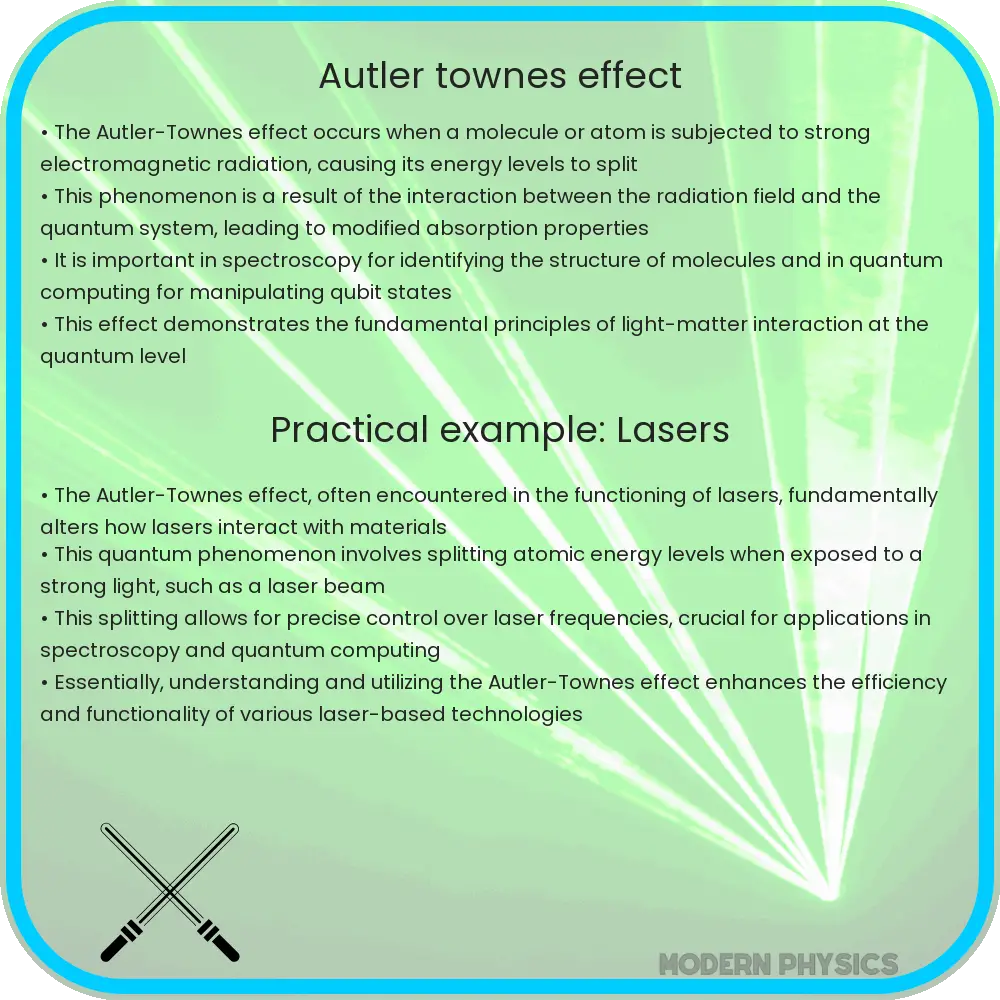
The Autler-Townes effect, sometimes referred to as the AC Stark effect or dynamic Stark effect, describes a phenomenon observed in quantum mechanics and optical physics. This effect involves the splitting of a spectral line into two separate components when an atom or molecule is exposed to a strong electromagnetic field, typically from a laser. The significance of the Autler-Townes effect is profound, offering key insights into the interaction of light with matter, and has applications ranging from spectroscopy to quantum computing.
Basic Principles
To understand the Autler-Townes effect, it’s essential to grasp some fundamentals of quantum mechanics, particularly the interaction between atomic energy levels and electromagnetic radiation. Atoms and molecules have discrete energy levels. When an electron transitions between these levels, it either absorbs or emits photons, leading to the phenomena typically observed in spectroscopy.
In the presence of a strong external electromagnetic field, such as that from an intense laser, the energy levels of the atom can become altered. The electric field of the laser interacts with the electric dipole moment of the atom, leading to shifts and splits in the atomic energy levels—a phenomenon analogous to the Zeeman effect where magnetic fields split energy levels, but caused by electric rather than magnetic fields.
Mechanism of Autler-Townes Splitting
Consider an atom that has an initial energy level structure composed of two levels: a ground state \(|g\rangle\) and an excited state \(|e\rangle\). When a laser field, resonant with a transition involving another state \(|f\rangle\), is applied, the interaction leads to the mixing of states and the energy levels get altered.
If the optical field is sufficiently strong and tuned close to the resonance frequency of the \(|e\rangle \rightarrow |f\rangle\) transition, it couples these states strongly, creating what are called “dressed” states. These are new quantum states that are superpositions (mixtures) of the original states, modified by the presence of the laser field. Mathematically, this can be expressed in terms of the Rabi frequency \(\Omega\), which characterizes the strength of the coupling:
\[|+\rangle = \cos(\theta)|g\rangle + \sin(\theta)|e\rangle\]
\[|-\rangle = -\sin(\theta)|g\rangle + \cos(\theta)|e\rangle\]
Here, \(\theta\) represents the mixing angle which depends on both the laser intensity and detuning (the difference between the laser frequency and the atomic transition frequency). The energy levels corresponding to these dressed states are shifted from the original levels by an amount \(\pm \frac{\hbar \Omega}{2}\), where \(\hbar\) is the reduced Planck’s constant.
Observation and Measurement
The splitting of the energy levels can be directly observed in the atomic absorption or emission spectra as two distinct peaks, effectively the signature of the Autler-Townes effect. This spectral splitting is different from the Doppler broadening or power broadening as it depends on the properties of the laser (like power and frequency) rather than the intrinsic properties of the atomic sample (like temperature).
Moreover, the detailed examination of the splitting provides insights into the quantum mechanical properties such as state lifetimes and coherences, offering a detailed view of the quantum state dynamics under the influence of a strong coherent light source.
Applications
The Autler-Townes effect is not just a theoretical curiosity but has practical applications across various fields of physics. In spectroscopy, it provides a method to resolve transitions between closely spaced energy levels that might otherwise be overlapped due to broadening effects. Additionally, its principle is fundamental in the development of quantum control methods used in quantum computing and information processing, where precise manipulation of quantum states is crucial.
In the next section, we will explore specific examples and further applications of the Autler-Townes effect, enhancing our understanding of its significance in modern science and technology.
Further Insights and Future Horizons
The exploration of the Autler-Townes effect continues to evolve, particularly as advances in laser technology improve the precision and control over electromagnetic fields. This ongoing advancement opens up new possibilities in the fields like high-resolution spectroscopy, where researchers can study extremely fine details of atomic and molecular structures.
Moreover, in the realm of quantum computing, understanding and utilizing the Autler-Townes effect facilitates the implementation of quantum bits (qubits) and gates, essential for the operation of quantum computers. By precisely manipulating the quantum states through controlled laser interactions, scientists are able to manage coherence and entanglement, the hallmarks of quantum computing.
Additionally, the Autler-Townes effect is instrumental in the study of quantum optics and photonics, contributing to the development of devices like optical switches and modulators, which are critical for optical communication systems. Such devices rely on the precise control of the optical properties of materials, achievable through phenomena like the Autler-Townes effect.
Conclusion
The Autler-Townes effect is a fascinating example of how quantum mechanics manifests in observable phenomena, providing profound insights into the interaction between light and matter. From the fundamental science of spectroscopy to cutting-edge applications in quantum computing and optical communications, the implications of this effect are vast and continuously expanding as technology advances.
As researchers delve deeper into the quantum world, the Autler-Townes effect remains a crucial tool not only for exploring fundamental principles but also for pioneering practical technologies that may one day transform our approach to information processing and communication. Thus, it represents a perfect blend of theoretical intrigue and practical utility, capturing the essence of both physics and engineering.