
Atomic parity nonconservation reveals violation of parity in atomic physics, crucial for understanding fundamental forces and advancing quantum technologies.
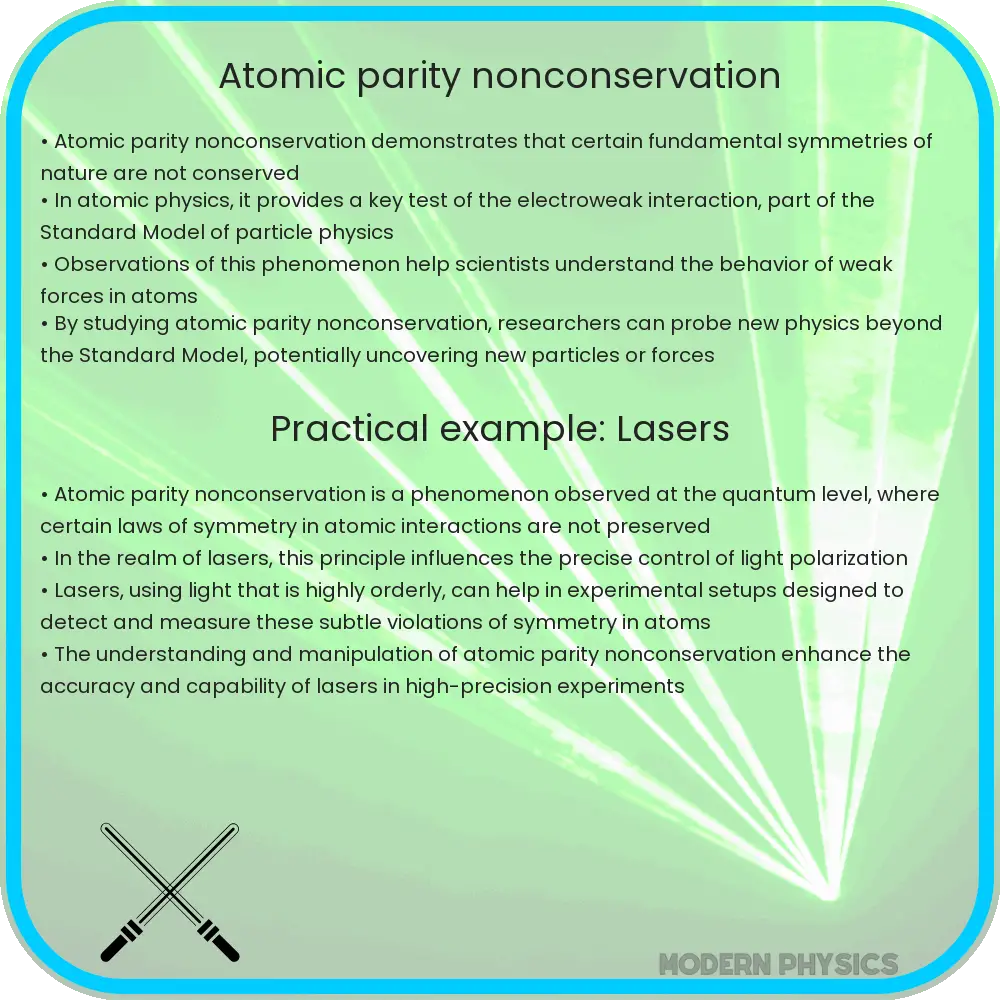
Understanding Atomic Parity Nonconservation
Atomic parity nonconservation (PNC) is a subtle yet consequential phenomenon observed in atomic physics that offers key insights into the fundamental forces of nature. It pertains to the violation of parity conservation—a principle that asserts the laws of physics should be the same, whether viewed in a mirror (called spatial inversion) or not. The exploration of parity nonconservation has profound implications in both theoretical physics and the practical understanding of the universe.
In classical physics, certain symmetries are expected to hold, one of which is parity. Parity is a measure of how the physical description of a system changes when its spatial coordinates are inverted. Historically, physicists believed that all physical laws were invariant under parity transformation. However, this view radically changed in the mid-20th century when experiments involving weak nuclear forces demonstrated that parity could indeed be violated.
The concept of atomic PNC specifically involves the interaction between electrons in an atom and the weak nuclear force—one of the four fundamental forces of nature that is also responsible for radioactive decay. Unlike the strong force, electromagnetism, and gravity, the weak force does not obey the conventional rules of parity conservation. When electrons within an atom interact through the weak force, they can exhibit behavior that would not be identical if viewed in a mirror.
The standard way to observe atomic PNC is through experiments that measure the small shifts in energy levels or optical transitions in atoms due to the weak interaction among subatomic particles. One of the most common methods involves the use of highly polarized light and measuring how its absorption by atoms differs with changes in light direction relative to the atomic structure. These measurements can be extremely sensitive, requiring precision instrumentation and control.
Impact and Applications of Atomic Parity Nonconservation
The study of atomic parity nonconservation is not just a theoretical pursuit but also has practical applications in enhancing our understanding of fundamental particles and their interactions. It provides direct evidence for the weak force’s role at very low energies, complementary to the information gathered from high-energy particle physics experiments like those conducted at the Large Hadron Collider (LHC). Understanding PNC helps physicists test the limits and consistency of the Standard Model of particle physics, which is the current best description of the fundamental particles and forces.
Moreover, investigating PNC can also lead to insights into new physics beyond the Standard Model. Any discrepancies between predicted and observed PNC effects could indicate the existence of new particles or forces not currently understood or described by existing theories. Thus, PNC is not only a test of the Standard Model but also a possible window into exploring new dimensions of physics that could explain dark matter, dark energy, or other unexplained phenomena.
Another significant impact of atomic PNC research is its potential application in technology, particularly in the fields of quantum computing and information processing. Understanding how atomic states can be manipulated using weak interactions opens up possibilities for developing new methods of controlling quantum systems, which is foundational for the advancement of quantum technology.
- Testing Standard Model predictions in low-energy experiments
- Searching for new particles and interactions
- Advancing quantum technology applications
Challenges in Observing and Measuring Atomic PNC
Despite its significant implications, observing and measuring atomic PNC poses technical and scientific challenges. The effects of parity nonconservation are extremely subtle and often masked by much stronger electromagnetic interactions in atoms. This requires experiments to be designed with high sensitivity and accuracy. Additionally, the precision needed in such experiments demands advanced technology and methodologies, often involving state-of-the-art lasers, detectors, and vacuum systems.
Furthermore, interpreting the results from these experiments can be complex. Theoretical calculations involved in predicting PNC effects need to account for various interactions and must be incredibly precise. Any small deviation or error in these calculations can lead to incorrect interpretations of experimental results. Consequently, ongoing advancements in computational physics are crucial for enhancing the accuracy of these predictions and for the effective analysis of data.
Future Prospects in Atomic PNC Research
The future of atomic PNC research is promising, with multiple avenues for exploration and improvement. Continued developments in experimental techniques are expected to enhance the detection of PNC effects. This includes improved accuracy of measurement instruments and innovative experimental setups that minimize background noise and other disruptive influences.
In tandem with experimental advancements, theoretical physics is also set to benefit from deeper investigations into atomic PNC. These studies not only refine our understanding of the weak force but also help in exploring the broader aspects of quantum mechanics and field theory. As theoretical models become more refined, they will provide clearer predictions that can be rigorously tested in experiments, thereby feeding back into better experimental designs.
Moreover, international collaboration among physicists and engineers is vital for advancing PNC research. Sharing insights, methodologies, and results can accelerate the development of new technologies and theoretical models, paving the way for groundbreaking discoveries that could transform our understanding of the universe.
Conclusion
Atomic parity nonconservation serves as a cornerstone in modern physics, offering profound insights into the fundamental aspects of nature. Through the intricate dance of electrons and weak nuclear forces, scientists have uncovered aspects of physical laws that challenge traditional understandings of symmetry and conservation. The ongoing study of atomic PNC not only tests the bounds of the Standard Model but also holds the potential to uncover new physics that could reshape our comprehension of the cosmos. With each experiment and theoretical innovation, we inch closer to unveiling the mysteries of the universe, marking an exciting era of discovery in both physics and applied technologies.