
Explore the world of aplanatic lens design, a key to achieving unmatched clarity, precision, and efficiency in optics, revolutionizing imaging technology.
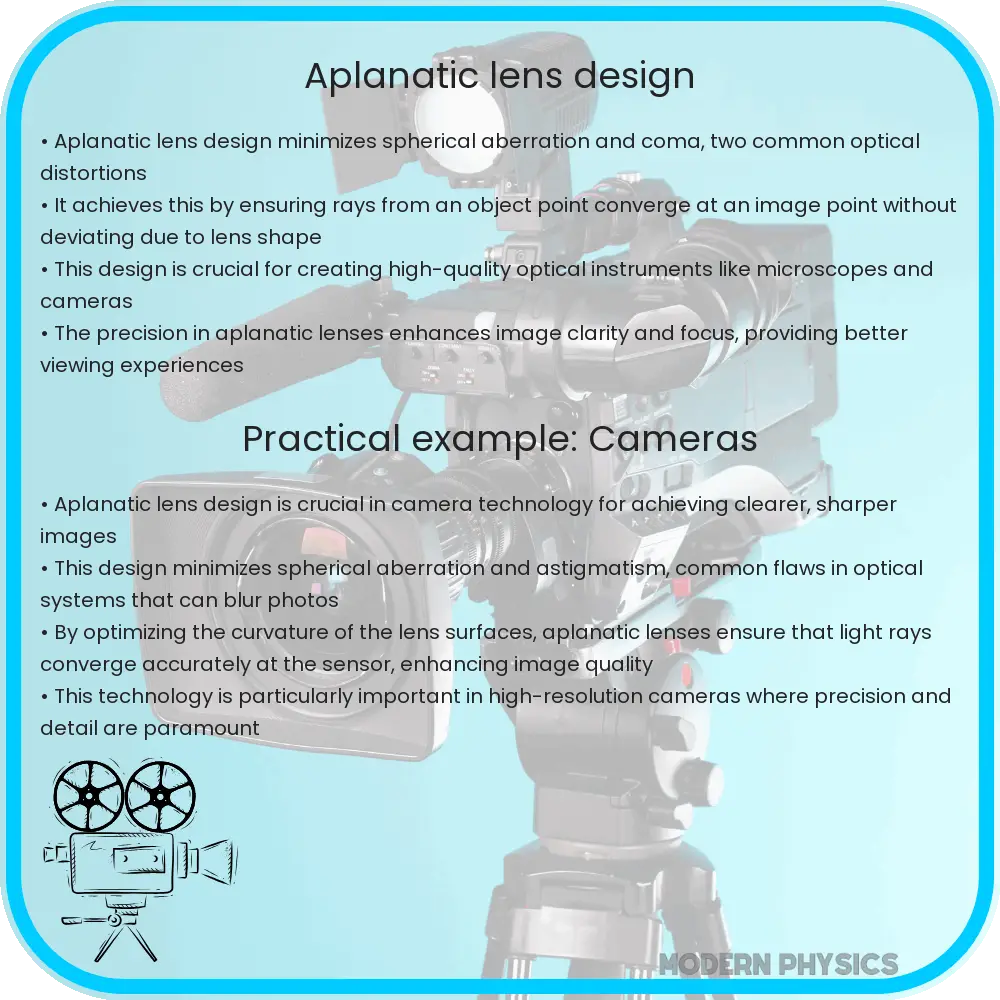
Aplanatic Lens Design: Clarity, Precision & Efficiency in Optics
The quest for the perfect optical lens has been a central theme in the advancement of optical engineering and photonics. Among the various innovations that mark this journey, the aplanatic lens stands out for its remarkable ability to minimize spherical aberration, a common optical flaw that distorts images. This article delves into the principles of aplanatic lens design, highlighting its significance in achieving unparalleled clarity, precision, and efficiency in optics.
Understanding Aplanatic Lenses
Aplanatic lenses are specially designed optical elements that aim to negate spherical aberration. Spherical aberration occurs when rays of light passing through a lens at different distances from the optical axis are not focused to the same point. This results in a blurred image, especially noticeable when using lenses with a large aperture or when focusing on a point source of light.
The design of aplanatic lenses involves careful shaping of the lens surfaces to ensure that all incoming light rays are refracted to converge at a common focal point, regardless of their distance from the optical axis. This is achieved through the use of specific curvature radii and refractive indices, calculated to correct for the spherical aberration inherently present in simpler lens designs.
Applications and Benefits
Aplanatic lens design finds its applications across a wide range of optical devices, including microscopes, telescopes, camera lenses, and even in the field of ophthalmology for vision correction. The primary benefit of incorporating aplanatic optics into these devices is the significant enhancement in image quality. By eliminating spherical aberration, these lenses provide sharper, more accurate images, which is critical for applications requiring high precision and clarity.
Moreover, the efficiency of aplanatic lenses in directing light to a focal point enhances the brightness and contrast of the observed images. This characteristic is particularly beneficial in low-light conditions, such as astronomical observations or microscopic examination of biological specimens.
In addition to improved image quality, the use of aplanatic lenses can lead to more compact and lightweight optical systems. Since these lenses can effectively correct aberrations without the need for multiple lens elements, they allow for simpler, more efficient designs. This is a crucial factor in portable devices, where size and weight are paramount.
Technological Advancements in Aplanatic Lens Design
The field of aplanatic lens design has seen significant technological advancements in recent years. Modern computational tools and precise manufacturing techniques have enabled the production of aplanatic lenses with unprecedented accuracy. The advent of computer-aided design (CAD) software allows for the simulation and optimization of lens properties before the manufacturing process begins, ensuring that each lens meets the highest standards of performance.
Material science has also played a pivotal role in the evolution of aplanatic lenses. The development of new optical materials with unique refractive properties has expanded the possibilities for lens designers. These materials can be tailored to specific wavelengths of light, further reducing aberrations and enhancing the performance of optical systems across a broad spectrum of applications.
Challenges and Future Directions
Despite the impressive capabilities of aplanatic lenses, challenges remain. One of the key issues is the cost and complexity of producing high-precision lens elements. Advanced aplanatic lenses require sophisticated manufacturing processes, which can be resource-intensive. Furthermore, the integration of these lenses into complex optical systems often necessitates additional calibration and alignment, adding to the overall complexity and cost.
Looking ahead, the future of aplanatic lens design is poised for further innovation. Researchers are exploring new geometric configurations and materials that promise even greater reductions in optical aberrations. Additionally, the integration of adaptive optics, which can adjust the lens shape in real time to compensate for dynamic aberrations, offers exciting possibilities for enhancing optical performance in varying conditions.
Conclusion
The development of aplanatic lenses represents a landmark achievement in the quest for perfect optics. By dramatically reducing spherical aberration, these lenses have opened up new vistas in clarity, precision, and efficiency for a wide array of optical devices. While challenges remain in their production and integration, ongoing technological advancements promise to further elevate the capabilities of aplanatic lens systems. As we look to the future, the continued refinement and innovation in aplanatic lens design will undoubtedly play a critical role in pushing the boundaries of what is possible in optical science and technology.
Is this conversation helpful so far?