
Explore the mesmerizing world of anamorphosis devices, where art meets optics to create stunning illusions. Discover the history, science, and artistry behind this optical magic.
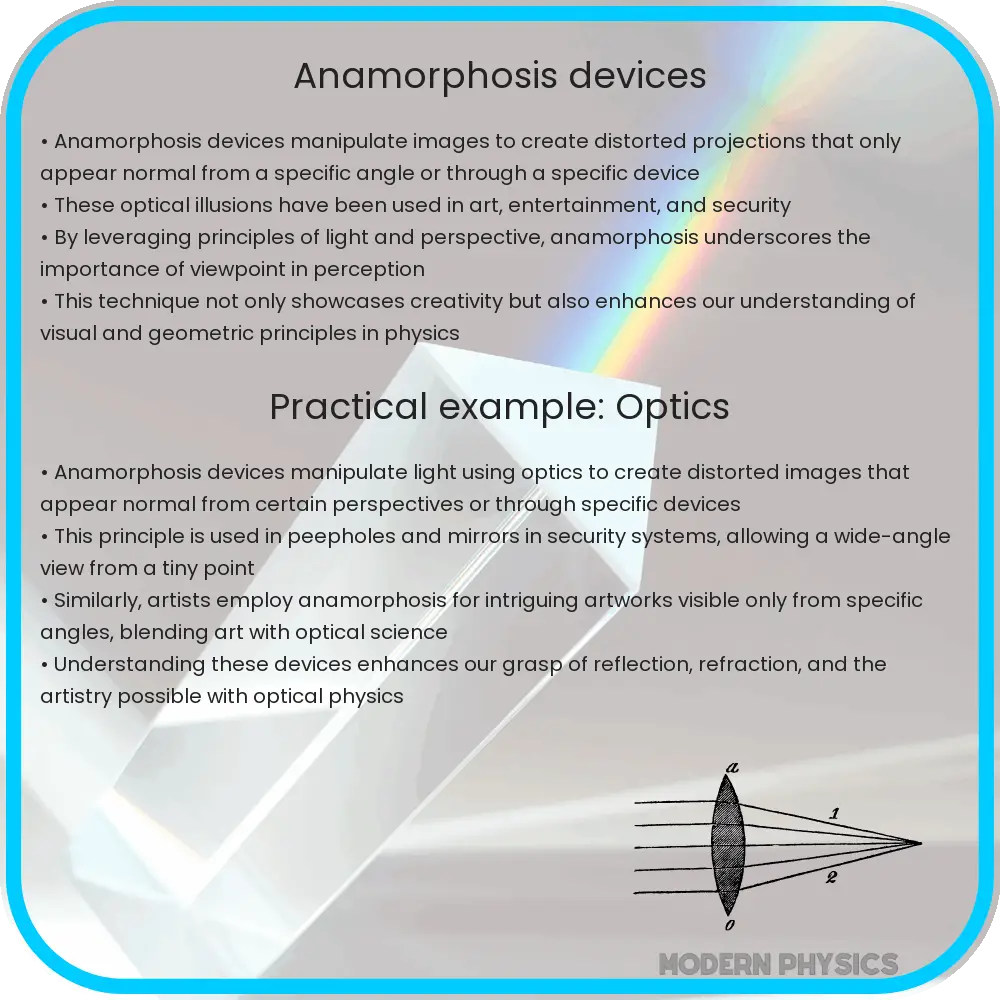
Anamorphosis Devices: Unveiling the Magic Behind Optical Illusions
Anamorphosis, a term that seems as intricate as the optical illusions it describes, is a fascinating art form that plays with the way we perceive spatial relationships. This technique manipulates the laws of perspective and optics, transforming distorted images into recognizable shapes when viewed from a specific angle or through a particular device. In this exploration, we delve into the historical roots, mechanisms, and artistic expressions of anamorphosis, shedding light on how this optical illusion has captivated minds for centuries.
The Historical Tapestry of Anamorphosis
The art of anamorphosis is no modern marvel. Its origins trace back to the Renaissance, a period ripe with scientific discovery and artistic experimentation. Artists and inventors of the time were fascinated by the principles of perspective and optical science, leading to the development of anamorphic art as a blend of curiosity, science, and creativity. Leonardo da Vinci is among the earliest known practitioners, with his anamorphic sketches serving as a testament to the technique’s early allure.
The Science and Artistry Behind Anamorphosis
At its core, anamorphosis relies on the principles of perspective and the manipulation of light and space. The technique involves distorting the image such that it appears normal or three-dimensional when viewed from a specific angle or through a special device, such as a cylindrical mirror or a conical device. This distortion is achieved by meticulously calculating the angles of projection and the viewer’s standpoint, creating a hidden image that magically reveals itself under the right conditions.
Anamorphic Devices: The Key to Hidden Worlds
The magic of anamorphosis is often unlocked through specially designed devices. Cylindrical and conical mirrors are classic examples, where a distorted image sprawled flat on a surface morphs into a precise depiction when reflected on the mirror’s curved surface. Similarly, viewing angles play a crucial role; an image stretched across a canvas can suddenly snap into a recognizable form as the observer moves to a specific point, offering a moment of surprise and revelation.
Anamorphosis is not just a trick of the eye but a sophisticated dance between art and optics. As we continue to explore this fascinating interplay, it becomes clear that anamorphosis is more than an artistic technique—it’s a window into the boundless possibilities of human perception and creativity.
Contemporary Applications and Innovations in Anamorphosis
In the modern era, anamorphosis has transcended its historical roots, finding its way into various fields such as street art, advertising, and even educational tools. Artists like Julian Beever and Edgar Müller have gained international fame for their breathtaking anamorphic street art, which transforms ordinary sidewalks into stunning three-dimensional scenes, visible only from a specific viewpoint. In advertising, anamorphic illusions are used to catch the eye of passersby, creating engaging and interactive brand experiences. Furthermore, educators and scientists use anamorphosis to explain complex concepts in physics and geometry, making the learning process both fascinating and visually stimulating.
The Intersection of Technology and Anamorphic Art
With the advent of digital technology, anamorphosis has embraced new dimensions of creativity and expression. Digital artists and programmers are experimenting with software and algorithms to create anamorphic images and installations that interact with viewers and environments in real-time. Augmented reality (AR) and virtual reality (VR) technologies are pushing the boundaries further, allowing users to experience anamorphic art in immersive 3D worlds, adding a dynamic component to the illusion that was previously impossible.
The Artistic and Psychological Impact of Anamorphosis
Anamorphosis does more than just trick the eye; it invites viewers to engage with art on a deeper level, challenging perceptions of reality and encouraging a playful exploration of the physical world. The moment of realization, when the chaotic becomes coherent, serves as a powerful metaphor for the human capacity to find order in disorder and meaning in the seemingly arbitrary. This psychological impact, combined with the visual spectacle, makes anamorphosis a compelling tool for artists and educators alike.
Conclusion
Anamorphosis stands at the crossroads of art, science, and technology, a testament to human creativity and the endless quest for innovation. From the intricate sketches of Leonardo da Vinci to the digital masterpieces of today, this optical illusion continues to evolve, captivating and inspiring audiences around the world. It challenges our perceptions, transforms our environments, and enriches our experiences, proving that the magic of anamorphosis is timeless. As we look to the future, it’s clear that this fascinating art form will continue to surprise and delight, blurring the lines between reality and illusion, and inviting us all to see the world from a different angle.