
Explore the world of anamorphic optics: lens distortion, scaling, and imaging in cinema and beyond. Discover how these lenses shape our visual experience.
An Introduction to Anamorphic Optics
Anamorphic optics are a fascinating and complex area of optical engineering, playing a crucial role in various applications ranging from cinematography to industrial processes. This technology involves the manipulation of light to produce images with specific distortions or scaling effects, often used to achieve unique visual results or correct optical aberrations.
Understanding Lens Distortion in Anamorphic Optics
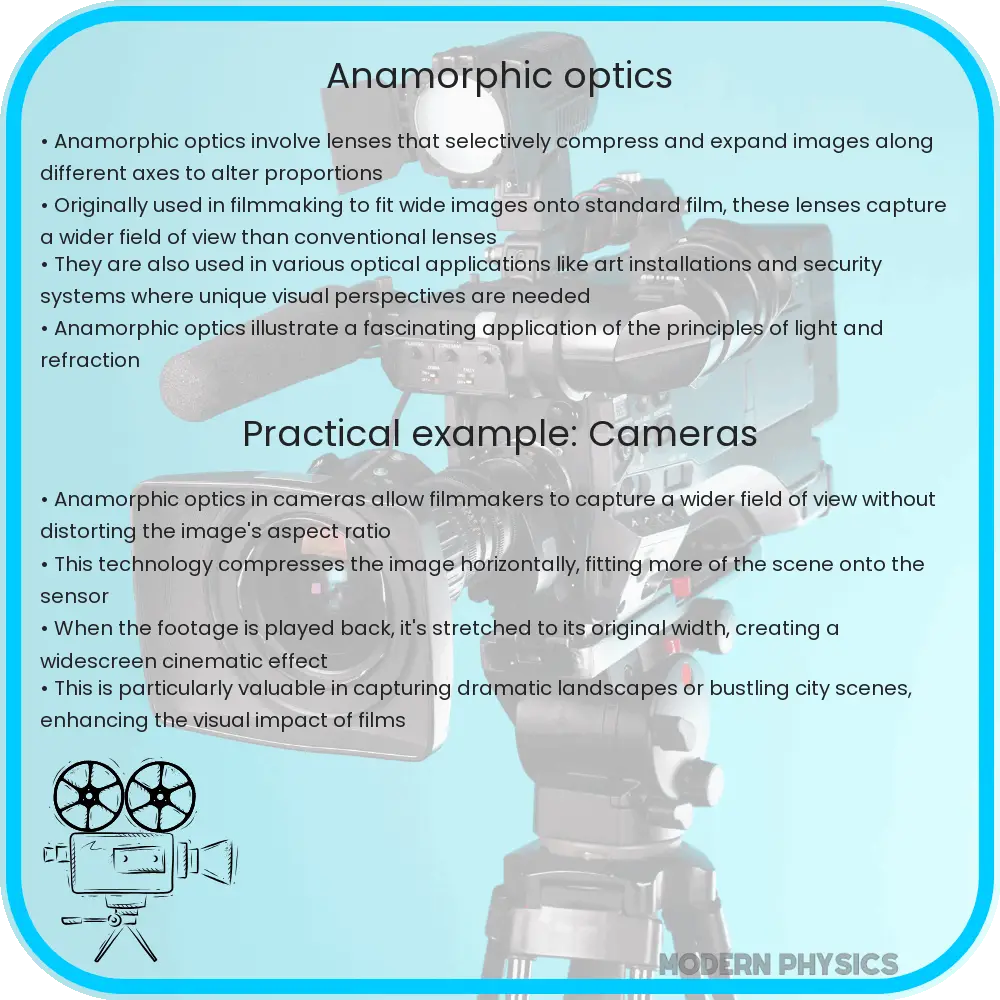
Lens distortion is a key aspect of anamorphic optics. This phenomenon occurs when a lens fails to produce a rectilinear image, resulting in a picture that appears stretched or compressed in certain dimensions. In anamorphic lenses, this distortion is deliberately controlled. Such lenses typically compress the image horizontally, which can then be expanded back to its natural aspect ratio during projection or post-processing. This technique is especially popular in the film industry, where it allows for the capture of wide aspect ratios on standard film stock.
The Science Behind Scaling and Imaging
Scaling is another crucial element of anamorphic optics. It refers to the process of altering the size of an image through optical means. In anamorphic lenses, scaling is not uniform; the horizontal and vertical dimensions of the image are scaled differently. This results in a unique form of image stretching or compression, which is essential for various optical applications like widescreen filmmaking.
Imaging in anamorphic optics is about how these lenses capture and project images. The unique scaling properties of anamorphic lenses allow them to record a wider field of view than standard spherical lenses. This is achieved without compromising the image resolution, which is particularly beneficial in high-definition imaging applications.
Applications of Anamorphic Optics
Anamorphic optics have diverse applications. In cinematography, they are used to create the widescreen cinematic look that is now a hallmark of the film industry. In industrial applications, these optics are utilized for precise measurements and imaging, where distortion can be a critical factor. The unique properties of anamorphic lenses also make them valuable in scientific research, particularly in fields requiring detailed imaging over wide areas.
This exploration of anamorphic optics reveals a world where light, mathematics, and artistic vision intersect. The control of lens distortion, scaling, and imaging opens up a plethora of possibilities in visual media and beyond, showcasing the innovative nature of optical technology.
Advanced Techniques in Anamorphic Optics
Delving deeper into anamorphic optics, advanced techniques such as cylindrical and prismatic elements come into play. These elements are integral in achieving the desired anamorphic effect. Cylindrical elements, for instance, stretch or compress the image in one direction, while prismatic elements can adjust the orientation and position of the image. These components are meticulously engineered to ensure precise control over the image dimensions.
Challenges and Solutions in Anamorphic Lens Design
Designing anamorphic lenses presents unique challenges. The asymmetrical scaling inherent in these lenses can lead to complexities in aberration control and image quality. Engineers and optical designers employ various strategies, such as using aspherical elements and advanced coatings, to mitigate these issues. These solutions help in maintaining high image fidelity and reducing unwanted optical artifacts like flares and ghosting.
Future Trends in Anamorphic Optics
The future of anamorphic optics is bright, with continuous advancements in technology paving the way for even more innovative applications. Emerging trends include the integration of anamorphic elements in compact consumer cameras and smartphones, allowing users to capture widescreen images and videos with ease. Additionally, the development of variable anamorphic lenses offers the flexibility to switch between different aspect ratios, a feature highly desirable in dynamic filming environments.
Conclusion
Anamorphic optics represent a remarkable fusion of artistic vision and scientific precision. From creating the iconic widescreen look in cinema to enhancing precision in industrial imaging, these lenses have opened new vistas in visual expression and technical application. The deliberate manipulation of lens distortion, scaling, and imaging in anamorphic lenses showcases the ingenuity of optical engineering. As technology advances, we can expect this field to evolve further, introducing new possibilities in both artistic and scientific realms. The journey of anamorphic optics is not just about bending light but also about expanding the horizons of human perception and creativity.