
Explore the role of MIT’s Alcator C-Mod in advancing nuclear fusion, focusing on its high magnetic fields and plasma density experiments.
Introduction to Alcator C-Mod Experiments
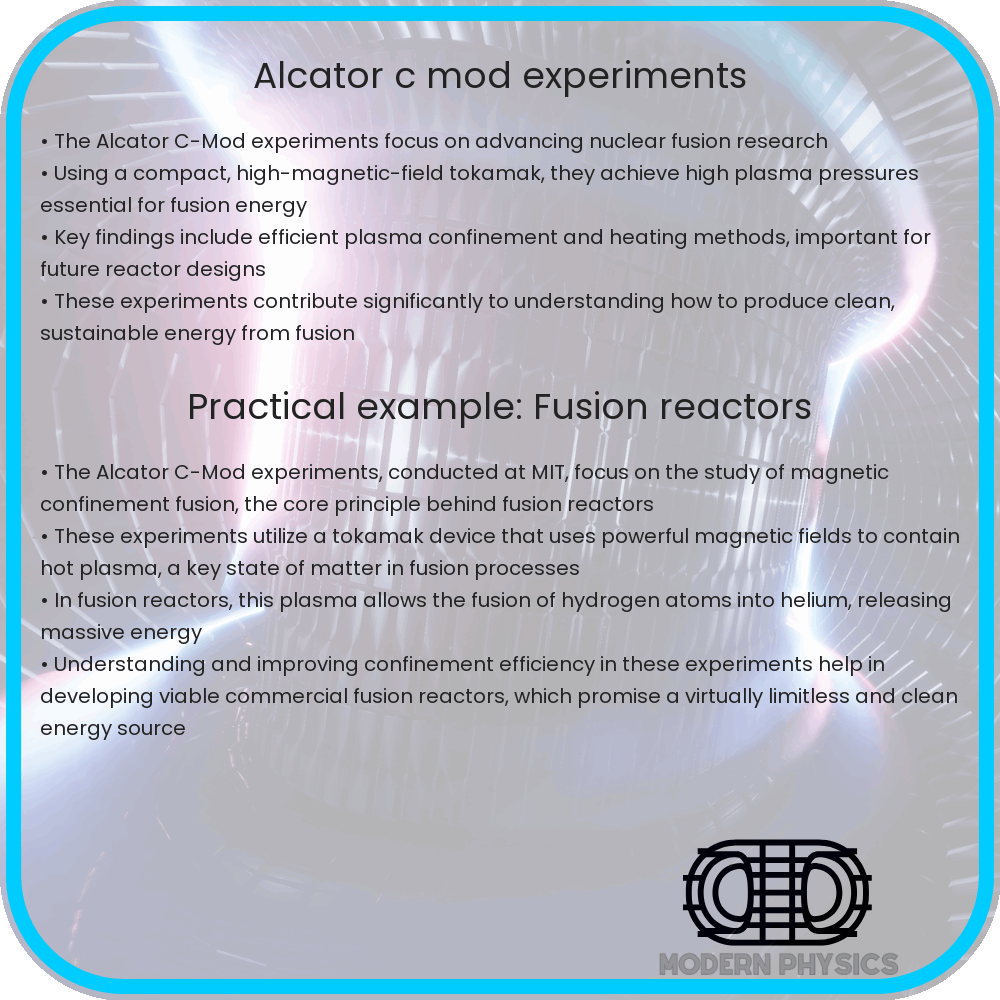
The Alcator C-Mod, a project based at the Massachusetts Institute of Technology (MIT), has been at the forefront of nuclear fusion research. This tokamak reactor, a type of magnetic confinement device used in producing controlled thermonuclear fusion power, has been instrumental in advancing our understanding of plasma physics, particularly in the context of energy production. The Alcator C-Mod’s unique capabilities in achieving high magnetic fields and plasma densities make it a critical asset in the international fusion research community.
The Cutting-edge Technology Behind Alcator C-Mod
Alcator C-Mod stands out due to its ability to create one of the highest magnetic fields and plasma pressures in a tokamak device. This is achieved through the use of a compact, high-field magnet system, which allows the device to reach magnetic fields up to 8 Tesla. Such high magnetic fields are crucial as they significantly increase the rate of fusion reactions, potentially making fusion energy more practical and sustainable.
Notable Experiments and Results
Over the years, numerous experiments conducted using the Alcator C-Mod have yielded groundbreaking results. One of the key achievements has been the detailed study of plasma turbulence. Turbulence in plasma can lead to inefficiencies in confinement, a major hurdle in sustaining fusion reactions. Alcator C-Mod’s experiments have helped develop new models that predict and control this turbulence, thus improving plasma confinement.
- H-mode Operation: The Alcator C-Mod was the first tokamak to achieve a fully developed high-confinement mode (H-mode) operation with a radio frequency (RF) power heating system. H-mode is a regime of operation that offers significantly better confinement and stability necessary for efficient fusion.
- Disruption Mitigation: Another significant aspect of experimentation involved the study of disruptions, which are sudden losses of plasma confinement. The insights gained from Alcator C-Mod have guided the development of techniques to predict and mitigate these disruptions in larger fusion devices.
Impacts of Alcator C-Mod on Global Fusion Research
The contributions of the Alcator C-Mod go beyond its direct findings. It has fostered international collaboration and has been a training ground for fusion scientists worldwide. The technologies and methodologies developed from its operations have real-world applications in the larger and more advanced reactors, such as ITER and future fusion power plants.
Furthermore, the data and models coming from Alcator C-Mod experiments have been integral in enhancing the design and operation of other fusion devices. They provide a benchmark for validating fusion concepts and contribute to the shared scientific foundation required to realize practical fusion energy.
In sum, Alcator C-Mod not only pushes the envelope in plasma physics and fusion technology but also serves as a beacon for collaborative scientific efforts. Its experiments have catalyzed advancements across several key areas of fusion research, highlighting its indispensable role in achieving the dream of sustainable, clean nuclear fusion power.
Future Directions and Innovations in Fusion Technology
Looking forward, the legacy of Alcator C-Mod continues to drive innovation in fusion technology. The research conducted has laid a robust groundwork for exploring novel materials that can withstand extreme conditions, as well as for developing more efficient plasma heating and confinement techniques. Future fusion reactors will benefit from these advancements, potentially leading to commercial fusion power generation that could revolutionize how we source energy.
Educational Role of Alcator C-Mod
Furthermore, Alcator C-Mod has playeed a crucial role in education and training in the field of nuclear fusion and plasma physics. By providing real-world applications and hands-on experiences, it has helped prepare the next generation of scientists and engineers who will continue to push the boundaries of what is technically possible in fusion energy.
Conclusion
The Alcator C-Mod has been a pivotal player in the field of nuclear fusion research. With its high magnetic field capabilities and its role in understanding and mitigating plasma turbulence and disruptions, it has significantly advanced our quest for a clean, sustainable energy source. The knowledge and technologies it has helped foster are shaping the future of global energy systems. It underscores the potential of fusion energy not just as a scientific endeavor but as a feasible solution to global energy challenges. As research progresses, the insights from Alcator C-Mod will undoubtedly continue to influence and inspire innovations in the fusion community for years to come.