
Insight into agricultural evaporation, its significant role in the hydrological cycle, and the precision techniques used for its measurement.
Agricultural Evaporation: Understanding Its Precision, Impact, and Measurement Techniques
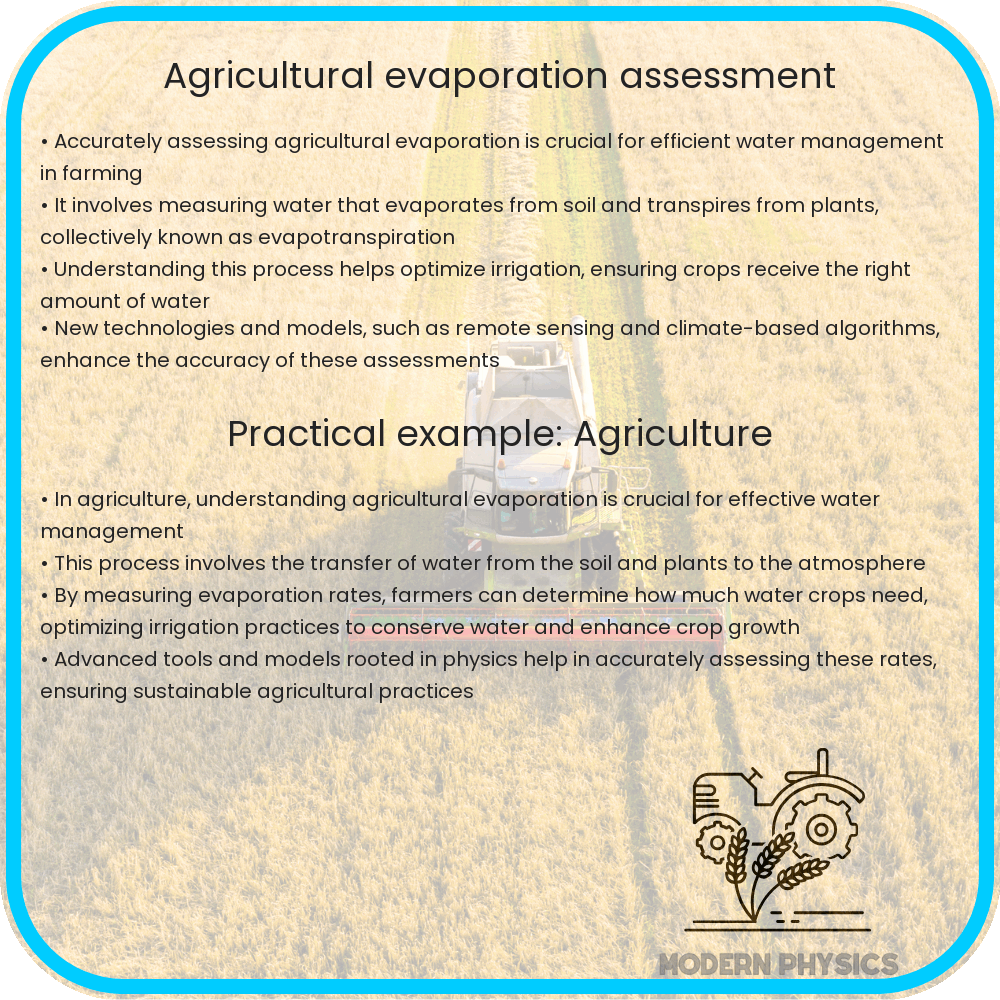
Evaporation from agricultural fields and bodies of water is a significant aspect of the hydrological cycle, influencing water management, climate regulation, and agricultural productivity. Assessing this evaporation with precision is crucial for developing effective water conservation strategies and ensuring sustainable agricultural practices.
What is Agricultural Evaporation?
Agricultural evaporation refers to the process whereby water is converted from liquid or solid states into vapor, which then leaves the surface of the earth. In agriculture, this primarily involves the evaporation of moisture from the soil and the transpiration of water from plants — commonly referred to together as evapotranspiration. This process is influenced by several factors including temperature, humidity, solar radiation, and wind.
Impact of Evaporation in Agriculture
The significance of accurately understanding and managing evaporation in agriculture cannot be overstressed. Evaporation affects soil moisture levels, which are directly linked to plant growth and crop yield. Excessive evaporation can lead to soil desiccation, reducing agricultural productivity and increasing the need for irrigation, thus escalating costs and impacting water resources. On the other hand, efficient use and conservation of water through controlled irrigation practices can enhance crop yields, conserve water, and reduce the environmental footprint of farming practices.
Techniques for Measuring Agricultural Evaporation
- Lysimeters: These are instruments used to measure the actual amount of evapotranspiration occurring in an area. A lysimeter consists of a container filled with soil and vegetation; the water loss due to evaporation and transpiration can thus be measured directly from this controlled environment.
- Eddy Covariance Systems: This technique measures the vertical turbulent fluxes within the atmosphere above the surface area. It provides data on how much water vapor is moving away from the surface, thereby offering insights into evaporation rates.
- Remote Sensing Techniques: These involve satellites and drones to measure various parameters such as surface temperatures, humidity levels, and vegetation indices. This data can be used to estimate evapotranspiration over large areas quickly and efficiently.
Each of these techniques has its strengths and limitations. Lysimeters provide highly accurate readings but are limited to small areas and specific conditions. Eddy covariance systems offer broader data but require complex calibration and can be influenced by local environmental factors. Remote sensing provides extensive coverage and is effective for large-scale assessments but may have lower accuracy and resolution issues compared to ground-based measurements.
Understanding these methods and their appropriate applications is key to achieving precise and effective evaporation assessments in agriculture. This knowledge not only aids in better water management but also facilitates informed decisions for sustainable agricultural practices.
Recent Advances in Evaporation Measurement Technologies
As technology progresses, new methods and improvements in measuring agricultural evaporation continue to emerge. Innovations such as enhanced sensor technologies and data integration systems are making it possible to gather more precise and real-time data. For instance, improvements in sensor calibration and the integration of AI for data analysis enable more accurate interpretation of evapotranspiration data. These advances assist in tailor-making irrigation systems that dynamically adjust to the observed conditions, thus optimizing water usage while maintaining crop health and productivity.
Future Challenges and Opportunities
Despite the advancements, several challenges remain in the field of agricultural evaporation measurement. One of the pressing issues is the scalability of accurate measurement systems to cover larger and more diverse agricultural regions. Additionally, the variability in climate conditions poses a constant challenge to maintaining accuracy in evaporation estimates. However, these challenges also present opportunities for innovation. Developing universally adaptable measurement techniques and enhancing predictive models through machine learning are potential areas for future research and development.
Conclusion
In conclusion, understanding and measuring agricultural evaporation is vital for efficient water management and sustainability in farming. The process of evaporation, influenced by environmental factors, significantly affects agricultural productivity and water resources. Techniques like lysimeters, eddy covariance systems, and remote sensing provide valuable data, helping to shape water conservation strategies. However, each method has its particular strengths and weaknesses depending on the application context. With ongoing technological advancements and the potential for upcoming innovations, the precision and efficiency of evaporation measurement are poised for further enhancement. Addressing current challenges will require collaborative efforts among scientists, engineers, and agricultural professionals to develop adaptable and robust solutions for diverse environmental conditions. Embracing these advancements and opportunities will be crucial for future sustainability in agriculture and water resource management.