
Explore how the agricultural energy balance assesses and optimizes the ratio of energy inputs and outputs in farming to improve sustainability and efficiency.
Understanding Agricultural Energy Balance
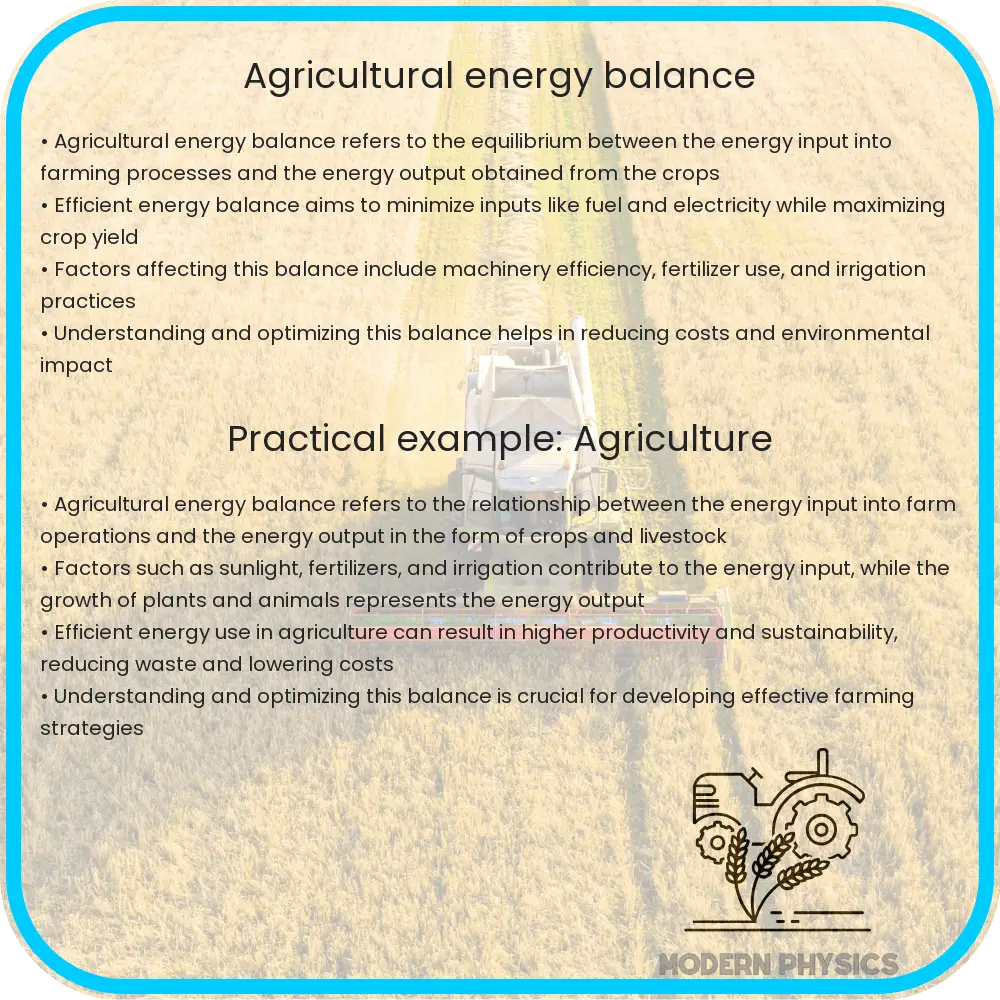
Agriculture is not just about sowing and reaping—it is a complex interplay of energy inputs and outputs that form the agricultural energy balance. Key to sustainable farming, this balance assesses how energy is consumed and generated in agricultural processes, aiming to enhance efficiency and minimize environmental impact.
Components of Agricultural Energy Balance
The agricultural energy balance can be summarized as the ratio of energy outputs (from agricultural products) to energy inputs (resources required for production). Inputs include chemical fertilizers, machinery use, irrigation systems, and pesticides, while outputs are the edible products and sometimes by-products used for energy like biofuels. The form of this relationship can be represented by the equation:
Energy Efficiency (EE) = (Energy output / Energy input) * 100%
Where a higher percentage indicates better efficiency and sustainability of the agricultural practices.
Energy Inputs in Agriculture
- Chemical Energy: This includes fertilizers and pesticides which are integral for preventing crop losses and enhancing yield.
- Mechanical Energy: Includes the fuel and electricity consumed by tractors, harvesters, and other machinery.
- Biological Energy: Involves the use of animal and plant residues, and extends to cover manure used in fields.
- Human Labor: Although often overlooked, human labor is a significant energy input, especially in less mechanized agricultural systems.
Sustainability in Energy Consumption
Sustainable agricultural practices aim to reduce dependence on non-renewable energy sources by optimizing input consumption and maximizing output. Practices such as integrated pest management, precision agriculture, and crop rotation contribute significantly to reducing chemical and mechanical energy inputs. Renewable energy technologies like solar-powered irrigation systems can also play a crucial role.
Innovations in Agricultural Energy Efficiency
Innovations in technology and practices can drastically improve the energy efficiency of agricultural systems. Some noteworthy advancements include:
- Automated and Robotic Systems: Drones for crop monitoring and automated harvesters streamline the energy expenditure by optimizing the usage and reducing waste.
- Genetic Engineering: Creating crop varieties that require less input of water, fertilizers, or pesticides helps in reducing the overall energy input while maintaining high yields.
- Resource Recycling: Using agricultural waste to produce energy—for instance, through anaerobic digestion to produce biogas—is a sustainable method of managing waste and producing energy concurrently.
Understanding and improving the agricultural energy balance is fundamental to achieving sustainable agricultural systems that are resilient and efficient. By examining how energy is used and implementing smarter practices and technologies, agriculture can meet the increasing global food demands without compromising the environmental health or depleting natural resources.
Challenges in Achieving Optimal Energy Balance
While the potential for improving agricultural energy balance is significant, there are challenges that must be addressed. These include the high upfront costs of more efficient technologies, resistance to change among traditional farmers, and the variability of weather conditions that can affect energy consumption patterns in agriculture. Educational outreach and governmental incentives can play vital roles in overcoming these hurdles.
Global Impact and Future Prospects
Optimizing agricultural energy balance has a direct impact not only on local farming communities but also on global scales. It affects global food security, climate change, and sustainable resource management. As the global population continues to grow, the urgency for sustainable agricultural practices becomes more pronounced. Future research and policy should focus on scalable solutions that can be adapted to diverse farming systems worldwide.
Conclusion
The agricultural energy balance is a pivotal concept in the realm of sustainable farming. By understanding and refining the energy inputs and outputs in farming practices, we can enhance food production efficiency, reduce environmental impacts, and support global food security. Innovations like precision agriculture, biogas production, and genetic engineering offer transformative potential. However, to fully realize this potential, it’s essential to address the barriers to adoption and invest in technologies that will lead to more sustainable, energy-efficient agricultural systems. As such, the journey towards a balanced agricultural energy system is not just a pathway to greater efficiency but also to a more sustainable and food-secure future.