
Explore the intriguing world of active matter, its non-equilibrium dynamics, and diverse applications in this comprehensive guide.
Understanding Active Matter: Exploring Non-Equilibrium Dynamics
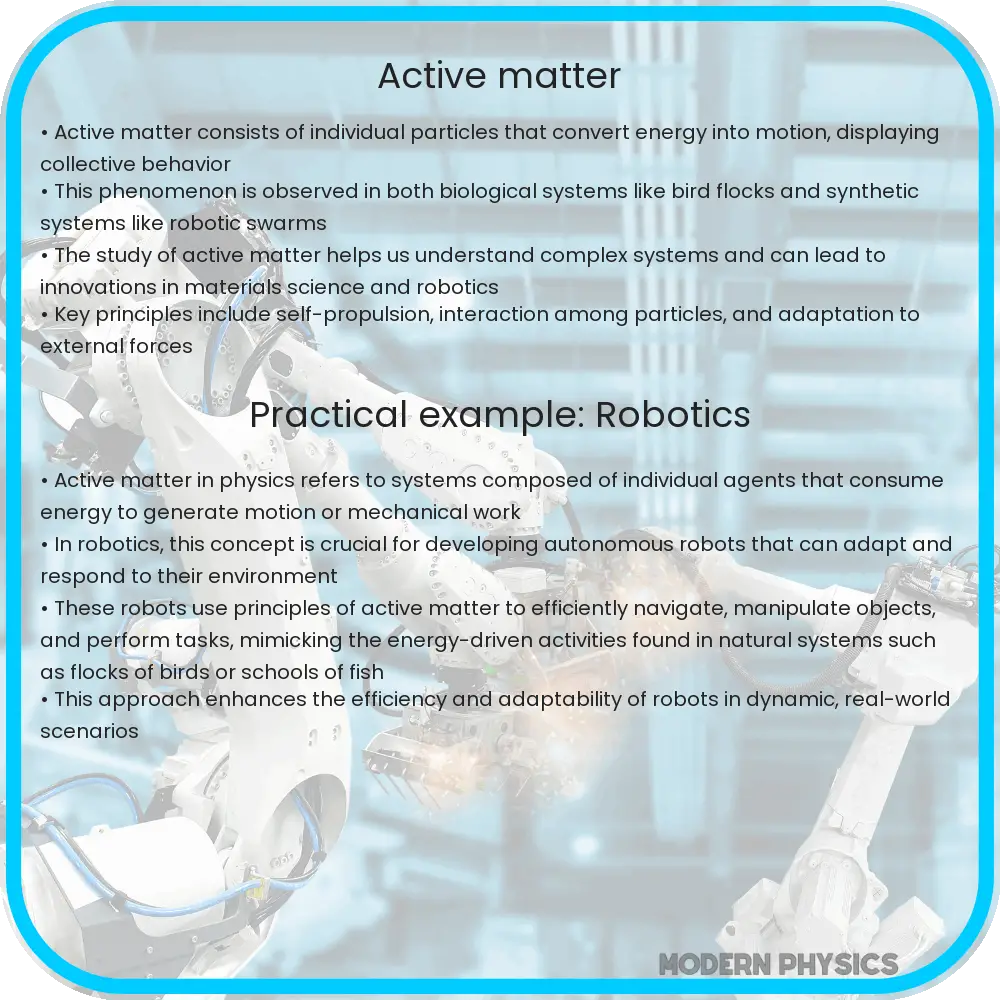
Active matter, a fascinating branch of physics, encompasses systems composed of individual units capable of consuming energy and converting it into motion. This field, transcending the boundaries of traditional physics, biology, and chemistry, has garnered significant attention due to its potential to revolutionize our understanding of non-equilibrium systems and their applications.
Key Characteristics of Active Matter
At the core of active matter lies the concept of non-equilibrium dynamics. Unlike passive systems that strive to reach thermodynamic equilibrium, active matter operates far from equilibrium, exhibiting complex and often unpredictable behaviors. These systems comprise components, such as biological cells or synthetic particles, which individually consume energy to generate motion or mechanical work. This energy consumption leads to rich dynamical phenomena, including self-organization, pattern formation, and collective behavior.
Biological and Synthetic Examples
- Biological Systems: Examples of active matter in biology include flocks of birds, schools of fish, and bacterial colonies. These systems demonstrate coordinated movement and collective behavior, essential for understanding biological processes at both the micro and macro scales.
- Synthetic Systems: In the realm of synthetic active matter, researchers create particles, often at the microscale, that mimic the autonomous motion of living systems. These include Janus particles, which have surfaces with two distinct physical or chemical properties, enabling them to move in fluids autonomously when energy is supplied.
Mathematical and Computational Modeling
To comprehend the complex behaviors of active matter, scientists employ advanced mathematical and computational models. These models help in predicting the collective dynamics of active systems, providing insights into their intrinsic properties. Understanding these dynamics is crucial for potential applications in areas such as drug delivery, environmental sensing, and the design of smart materials.
Applications in Diverse Fields
The study of active matter opens doors to numerous applications. In biomedicine, for instance, understanding the mechanics of cellular components can aid in the development of targeted drug delivery systems. Environmental sensing and pollution cleanup are other areas where active matter principles can be applied. The field’s interdisciplinary nature allows for innovative solutions to complex problems, blending physics, chemistry, and biology.
This exploration of active matter and its non-equilibrium dynamics offers a glimpse into a world where the boundaries of conventional science are expanded, paving the way for novel applications and deeper understanding of the natural world.
Challenges and Future Directions in Active Matter Research
Despite the promising applications of active matter, the field faces several challenges. One of the primary difficulties lies in controlling and manipulating these systems at the micro and nanoscale. Achieving precise control over the behavior of active particles is crucial for practical applications. Additionally, understanding the interactions between active particles and their environment poses a significant challenge, requiring advancements in both experimental and theoretical frameworks.
Interdisciplinary Collaboration: A Key to Advancements
The advancement of active matter research relies heavily on interdisciplinary collaboration. Integrating expertise from physics, chemistry, biology, and engineering is essential for overcoming the challenges and unlocking the full potential of active matter. Collaborative efforts can lead to the development of more sophisticated models and experimental techniques, facilitating a deeper understanding of non-equilibrium dynamics.
Technological Innovations and Societal Impact
The implications of active matter research extend beyond academic curiosity, potentially leading to groundbreaking technological innovations. For example, the development of self-healing materials, adaptive architectural structures, and advanced robotics systems are all within the realm of possibility. These advancements could have a profound impact on various sectors, including healthcare, environmental management, and industry.
Conclusion
Active matter, with its inherent non-equilibrium dynamics, represents a frontier in scientific research, offering a window into the complex behaviors of systems driven far from equilibrium. The interdisciplinary nature of this field, combining insights from physics, biology, and chemistry, paves the way for innovative applications and technological advancements. While challenges remain, particularly in terms of control and manipulation at small scales, the potential for societal impact is immense. As research in this area continues to evolve, it holds the promise of transforming our understanding of the natural world and enabling solutions to some of the most pressing challenges of our time.
Embracing the complexities of active matter, scientists and engineers are set to unlock a plethora of opportunities, heralding a new era of scientific discovery and technological innovation.