
Explore the impact of material absorption and geometrical dispersion on acoustic waveguide losses, vital for enhancing sound systems.
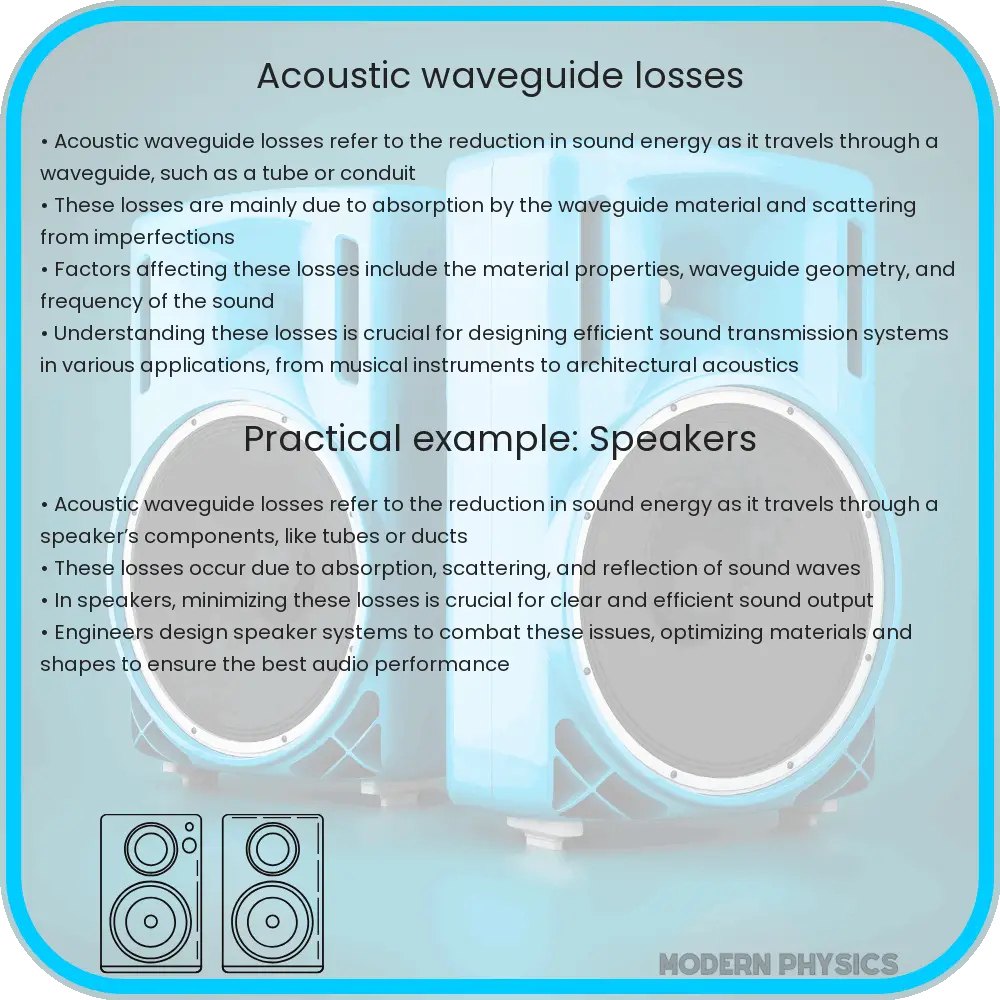
Understanding Acoustic Waveguide Losses
When designing and utilizing acoustic waveguides, such as in speakers, musical instruments, or architectural acoustics, understanding and minimizing losses is crucial for optimal performance. Acoustic waveguide losses refer to the reduction in energy of sound waves as they travel through a waveguide due to various factors including absorption, scattering, and diffraction.
Analysis of Acoustic Waveguide Losses
The primary contributors to acoustic losses in waveguides are material absorption and geometrical dispersion. Material absorption is the loss of energy due to the inherent properties of the materials used in the waveguide construction. This energy is typically converted into heat. Geometrical dispersion, on the other hand, occurs when the shape and dimensions of the waveguide cause spreading of the wavefront, leading to a decrease in the energy density of the sound field.
- Material Absorption: The extent of absorption depends largely on the type of material and its internal structure. Porous materials, for example, have higher absorption rates due to their ability to trap and dissipate sound energy.
- Geometrical Dispersion: This form of loss is influenced by the cross-sectional area and length of the waveguide. Sharp bends or irregular shapes can significantly increase dispersion losses.
Detailed analysis of these factors is typically carried out using complex mathematical models and simulations. The transmission loss (TL) can be expressed using the equation:
TL = 10 * log10(Pin / Pout) dB
where Pin is the input power and Pout is the output power of the waveguide.
Reduction of Acoustic Waveguide Losses
To minimize losses in acoustic waveguides, several strategies can be deployed:
- Material Selection: Choosing materials with lower absorption coefficients can inherently reduce energy losses.
- Waveguide Design: Designing the waveguide with smooth transitions, optimal bending angles, and regular cross-sectional areas can reduce geometrical dispersion.
- Surface Treatment: Reducing surface roughness or adding specialized coatings can minimize scattering losses at the boundaries of the waveguide.
By optimizing these elements, engineers can significantly enhance the acoustic performance of waveguides, leading to clearer sound transmission and reduced distortions.
Implications of Improved Acoustic Waveguide Design
Enhanced acoustic waveguide design doesn’t only benefit the clarity and quality of sound in audio equipment and musical instruments but also plays a vital role in architectural design, particularly in spaces like concert halls and theaters. Effective waveguide management can ensure sound waves are directed and maintained precisely, enhancing the listener’s auditory experience.
- Audio Equipment: In loudspeakers and headphones, improved waveguide design leads to more efficient transmission of sound, meaning less power is required to achieve high-quality audio output.
- Architectural Acoustics: In buildings, better waveguide handling can prevent sound from dispersing in unintended directions, thereby decreasing noise pollution and increasing the intelligibility of speech and music within designed spaces.
Furthermore, the reduction in energy loss translates directly into reduced operational costs and energy consumption, making systems more sustainable and environmentally friendly.
Future Directions in Acoustic Waveguide Research
Continued research in acoustic waveguide technology promises further enhancements in sound quality and energy efficiency. Innovations such as metamaterials, which can manipulate waves in ways conventional materials cannot, offer exciting possibilities. These materials can potentially revolutionize how we control sound propagation, leading to even more precise and efficient acoustic waveguides.
- Metamaterials: These materials can be engineered to have properties that do not occur naturally, potentially allowing for the perfect absorption of sound without geometrical dispersion.
- Computational Modeling: Advances in software and computing power will continue to improve the accuracy of simulations, making it possible to predict and mitigate losses in waveguide designs more effectively.
Such advancements not only hold the promise for better consumer products but could significantly impact noise control in industrial and urban environments.
Conclusion
Understanding and managing acoustic waveguide losses is fundamental in various fields, from audio engineering to architectural design. Through detailed analysis of material absorption and geometrical dispersion, and the strategic application of design modifications, significant improvements can be made in sound quality and energy efficiency. Further research and development in this area, particularly through the use of innovative materials and enhanced computational models, will continue to push the boundaries of what is possible in acoustic management. This is not just about achieving clearer sound or more precise directional audio; it’s about creating environments that are acoustically optimized, leading to better experiences and sustainability.