
Acoustic spectroscopy analyzes properties of materials by studying sound waves’ interaction, using frequency and amplitude changes for precise, non-destructive analysis.
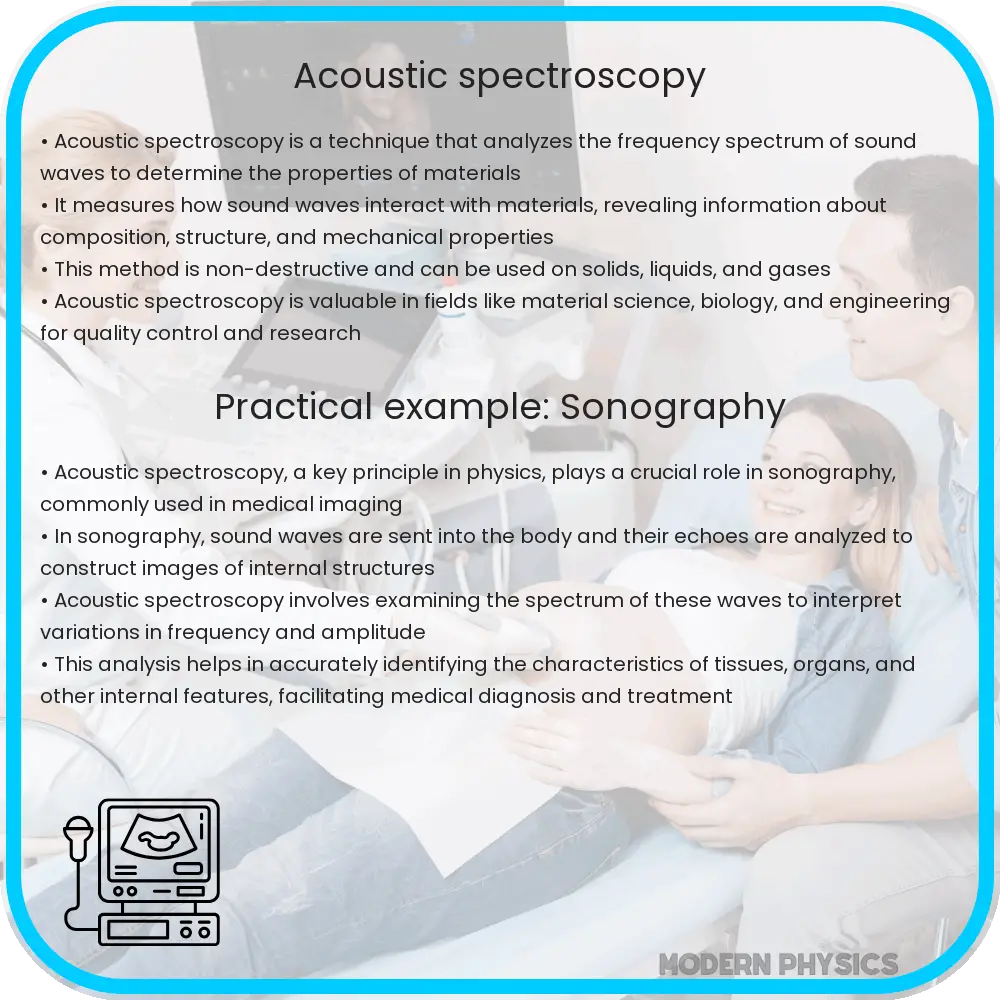
Understanding Acoustic Spectroscopy: Precision, Analysis, and Waveforms
Acoustic spectroscopy is a fascinating domain within the larger field of spectroscopy, focused on the study and manipulation of sound waves to analyze the properties of materials. This technique is highly valued for its non-destructive nature and its precision in determining the characteristics of different substances. Acoustic spectroscopy involves emitting sound waves at various frequencies into a material and measuring how these waves change as they pass through or reflect off the material.
The Basics of Sound Waves in Acoustic Spectroscopy
Sound waves are a type of mechanical wave consisting of vibrations that propagate through a medium (such as air, water, or solids). These waves carry energy from one location to another, generally in the form of oscillating pressure and displacement of particles in the medium. In acoustic spectroscopy, these properties are critical as they influence how sound waves interact with different materials.
The general form of a sound wave can be described by the equation:
s(t) = A * sin(2πft + φ)
- A is the amplitude, indicating the maximum pressure variation within the wave.
- f represents the frequency, denoting how many wave cycles occur in a second.
- φ is the phase, describing the wave’s displacement relative to a reference point at time t.
Understanding these parameters helps in analyzing how materials affect the propagation of sound waves. Different materials will reflect, absorb, or transmit these waves differently based on their density, elasticity, and structure.
Waveforms and Their Significance
When studying acoustic spectroscopy, identifying and analyzing waveforms is a crucial skill. Waveforms—graphical representations of sound waves—reveal crucial information about the sound’s characteristics. By analyzing the waveform of a sound wave that has interacted with a material, specialists can deduce various material properties such as texture, density, and even abnormalities.
For instance, a high-frequency sound wave that passes through a dense object might emerge with diminished amplitude and altered frequency, indicating not only the object’s density but potentially its composition as well. Acoustic spectroscopy makes significant use of this data in fields ranging from material science to biomedicine, where precision in such measurements is of paramount importance. For materials like polymers, ceramics, and biological tissues, where other forms of analysis might be damaging or less effective, acoustic spectroscopy provides a powerful alternative for non-invasive and highly precise analysis.
Detailed analysis of acoustic waveforms can also pinpoint the location of flaws in structural components. The waveform’s amplitude, frequency, and phase can change in predictable ways based on common imperfections, providing essential feedback in industrial applications where material integrity is crucial. This capability makes acoustic spectroscopy a key tool in predictive maintenance and quality control in various engineering fields.
The precision in acoustic spectroscopy arises not just from the ability to detect and analyze detailed waveforms but also from the advancements in technology that allow clearer, more accurate representation of sonic interactions. Devices with high-resolution sensors and advanced data processing algorithms are capable of capturing and analyzing subtle changes in wave properties, which leads to more definitive interpretations and conclusions.
Applications of Acoustic Spectroscopy
Acoustic spectroscopy’s diverse applications span multiple industries, reflecting its versatility as a diagnostic tool. In the medical field, it is used for imaging and diagnosis, providing a safer alternative to X-rays by employing non-ionizing radiation. In material sciences, researchers utilize acoustic spectroscopy to analyze structural integrity in composite materials, helping to identify potential failures before they occur. Additionally, the petroleum industry employs this technology to analyze rock or sediment samples, aiding in the exploration of new oil fields.
Art preservation is another innovative area of application. Experts can assess the condition of historical artifacts and artworks, identifying degradation that isn’t visible to the naked eye. This method offers a non-invasive way to diagnose and monitor the health of precious historical objects over time.
Future Prospects in Acoustic Spectroscopy
As technology continues to evolve, the potential for acoustic spectroscopy grows. Future advancements may lead to even more sensitive devices capable of detecting finer nuances in materials. Additionally, integrating artificial intelligence with acoustic spectroscopy could automate analysis processes, increasing efficiency and accuracy, especially in complex diagnostic scenarios such as real-time monitoring of industrial structures or live tissue analysis during surgical procedures.
The continued development of portable, robust acoustic spectroscopic devices also promises to expand the use of this technology in remote or harsh environments, providing critical data in fields like disaster management, environmental monitoring, and field-based research.
Conclusion
Though it may seem specialized, acoustic spectroscopy is a remarkably versatile and powerful tool in both research and practical applications. Its ability to provide detailed, non-destructive analysis makes it invaluable across various fields, from medical imaging to art conservation. By understanding the principles of sound waves and their interaction with different materials, scientists and engineers can harness the power of acoustic spectroscopy to glean insights that were previously impossible or required more invasive methods.
The synergy of advanced sensors, improved data processing algorithms, and potential future innovations like AI integration, heralds a bright future for acoustic spectroscopy. This domain not only enhances our understanding of the physical world but also contributes to the safety, maintenance, and exploration of new frontiers in science and engineering. As technology advances, so too will the capabilities and applications of acoustic spectroscopy, making it a field worth watching for anyone interested in the leading edge of science and technology.