
Understanding the force exerted by sound waves known as acoustic radiation pressure, its principles, applications, and effects.
Understanding Acoustic Radiation Pressure
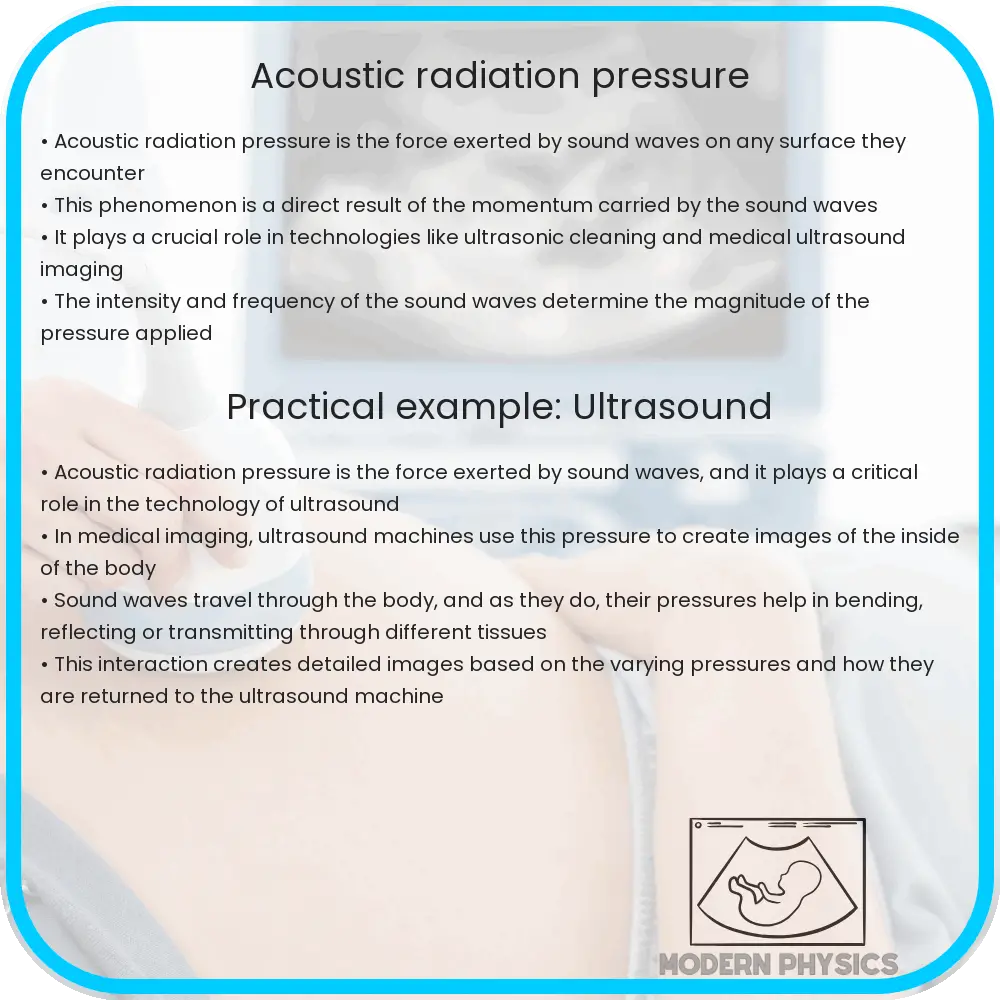
Acoustic radiation pressure is a physical phenomenon associated with the force exerted by sound waves. Whenever these waves travel through a medium—be it air, water, or solids—they carry momentum. Upon encountering surfaces or particles, this momentum is transferred, exerting pressure known as acoustic radiation pressure.
Basic Physics Behind Acoustic Radiation Pressure
The core principle that underlines acoustic radiation pressure is the conservation of momentum. Sound waves, which consist of longitudinal waves with alternating compressions and rarefactions of particles in the medium, transfer their momentum to objects they encounter. The formula to calculate acoustic radiation pressure P when a wave is perfectly absorbed by a surface is:
P = 2I/c
where I is the intensity of the sound wave (measured in watts per square meter), and c is the speed of sound in the medium (measured in meters per second).
Uses and Applications of Acoustic Radiation Pressure
- Medical Imaging: In the field of medical diagnostics, acoustic radiation pressure is employed in techniques like elastography, where it is used to measure the stiffness or elasticity of soft tissue, helping in the detection of tumors or liver diseases.
- Material Manipulation: In the manufacturing sector, specifically in processes like ultrasonic welding, acoustic radiation pressure is used to join materials. The pressure welds the material without the need for additional solder or adhesives.
- Acoustic Levitation: Arguably one of the most fascinating applications, acoustic levitation uses the radiation pressure of intense sound waves to lift and manipulate small objects or liquids without physical contact. This technique is useful in chemical analysis, materials science, and even assisting in the delicate assembly of small electronic components.
Effects of Acoustic Radiation Pressure
While acoustic radiation pressure has beneficial uses, its effects can also pose certain challenges:
- Auditory Impact: High-intensity sound waves, while useful in various technologies, can potentially lead to hearing loss or discomfort if not properly managed.
- Structural Vibrations: Excessive exposure of structures to high-energy acoustic waves can induce vibrations that may compromise structural integrity over time.
- Biological Disruption: In marine environments, intensive acoustic pressures (like those from sonar equipment) can disturb or harm aquatic life, affecting their internal navigation and communication systems.
Future Prospects in Acoustic Radiation Pressure Technology
The advancement of technology constantly opens new doors for the application of acoustic radiation pressure. Innovations are particularly promising in the realms of non-invasive surgery, where precise and controlled use of ultrasound can target tumors or problematic tissues without harming surrounding areas. Advances in acoustophoretic transport – the process of moving particles, cells, and even small organisms using sound waves – are also expected to revolutionize fields like pharmaceutical manufacturing and environmental management.
Additionally, the exploration of acoustic radiation pressure in the aerospace industry for manipulating particulate matter in zero gravity conditions presents an exciting frontier. Such advancements could improve long-term space missions by enabling better control over microenvironments.
Conclusion
Acoustic radiation pressure is a remarkable demonstration of the momentum carried by sound waves and its tangible effects on the world around us. From its critical applications in medical imaging and material manipulation to the potential impacts on non-invasive medical treatments and space exploration, the phenomenon harnesses both the power and subtlety of sound. While the applications bring significant benefits, they also require mindful consideration of the environmental and health impacts, particularly in high-intensity settings.
By continuing to understand and harness the capabilities of acoustic radiation pressure, scientists and engineers can push the boundaries of what is possible in both the macroscopic and microscopic realms. The ongoing research and development in this area not only promise to expand its existing applications but also open new possibilities for its use in improving human life and understanding the natural world. The intersection of physics and engineering in acoustic radiation pressure showcases the fascinating ways in which fundamental scientific principles can manifest in practical, cutting-edge technology.