
Explore the fascinating world of accretion disk coronas in astrophysics, understanding their formation, impact, and the challenges in studying these cosmic phenomena.
Understanding Accretion Disk Coronas in Astrophysics
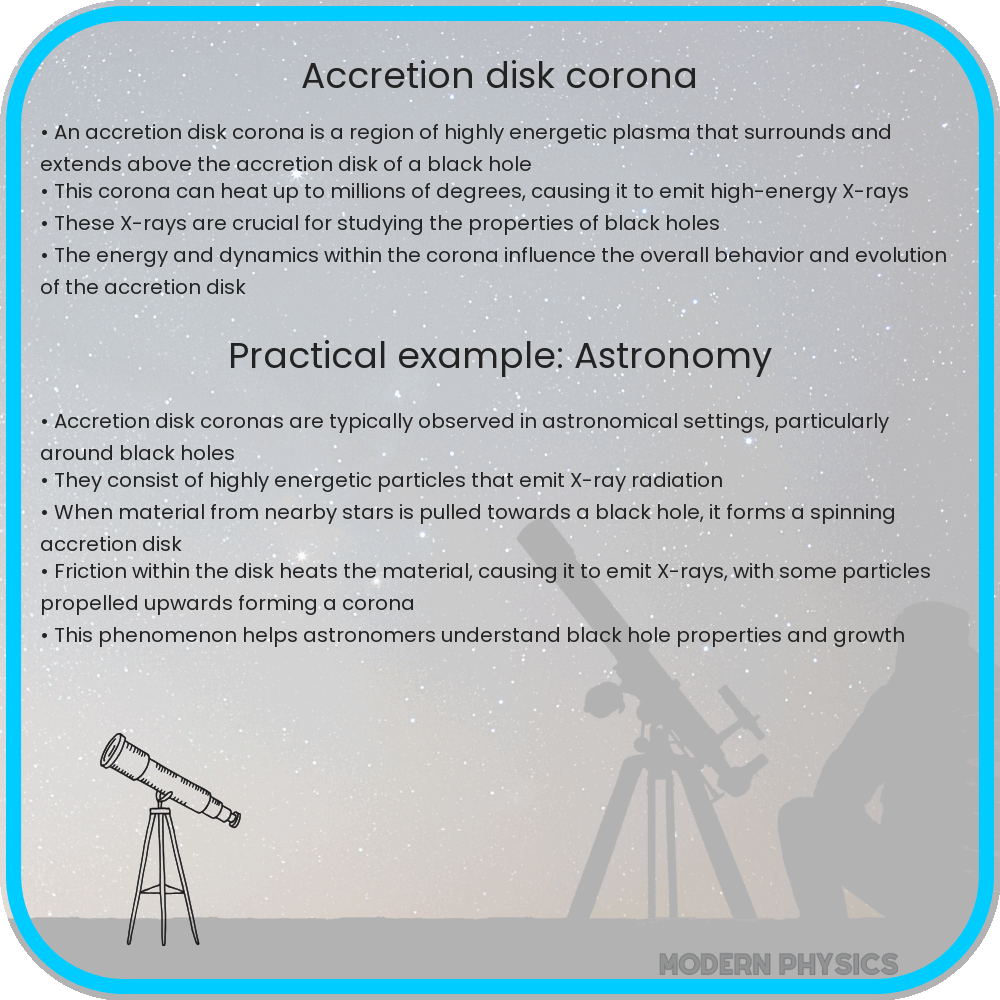
The concept of an accretion disk corona plays a crucial role in the field of astrophysics, particularly in the study of celestial bodies like black holes and active galactic nuclei (AGN). An accretion disk is a structure often found around a central object, such as a star, planet, or black hole, formed by diffused material in orbital motion. The “corona,” however, is a less understood component, typically referring to a highly energetic and hotter outer layer of the accretion disk.
Formation of Accretion Disks and Coronas
Accretion disks form as a result of the conservation of angular momentum. Material falling towards a central mass loses potential energy, which gets converted into heat, causing the material to emit radiation. This process flattens the material into a disk. The corona forms above the disk, heated by processes that may include magnetic reconnection or the dissipation of magnetic energy from the disk itself. The intense heat and energy within the corona can ionize nearby gas, turning it into plasma and giving rise to X-ray emissions observed from earth.
Impact of Accretion Disk Coronas in Astrophysics
The study of accretion disk coronas is essential for understanding high-energy phenomena in the universe. For instance, the corona can significantly affect the observed spectrum of X-ray emissions from AGNs and black holes. The X-rays produced in the corona can illuminate the underlying disk, providing critical information about the physics of accretion and the properties of the central object. Additionally, the interaction between the disk and its corona plays a pivotal role in the dynamics of jet ejections and the overall evolution of the accreting system.
The behavior and characteristics of accretion disk coronas are key to unraveling the mysteries of cosmic phenomena. Their study contributes to our understanding of the universe’s most energetic events and the nature of matter under extreme conditions.
Research and Challenges in Accretion Disk Corona Studies
The study of accretion disk coronas involves sophisticated observational techniques and theoretical models. X-ray telescopes, such as NASA’s Chandra X-ray Observatory and ESA’s XMM-Newton, are instrumental in detecting the high-energy radiation emitted by these coronas. Through these observations, scientists can deduce the corona’s size, temperature, and other physical properties. However, modeling these complex systems is challenging due to the extreme conditions and intricate physics involved, including general relativity and plasma physics.
Another challenge in studying accretion disk coronas is the variability of these systems. Many AGNs and black hole systems show significant changes in their X-ray luminosity and spectra over time. This variability can provide insights into the processes occurring within the corona and the accretion disk, but it also complicates the analysis and interpretation of observational data.
Furthermore, the exact mechanism of corona formation and its relationship with the accretion disk remains an area of active research. Theories suggest that magnetic fields play a crucial role in both the heating of the corona and the transport of angular momentum within the disk. However, the details of these processes and their interplay are still being unraveled.
Conclusion
The study of accretion disk coronas is a vibrant and challenging field in astrophysics, offering insights into some of the most extreme and energetic phenomena in the universe. The interaction between the accretion disk and its corona is crucial for understanding the behavior of black holes, AGNs, and other accreting systems. Despite the complexities and challenges in studying these phenomena, advances in observational technology and theoretical modeling continue to shed light on the nature of accretion disks and their coronas. As research progresses, our understanding of these celestial phenomena will deepen, further uncovering the mysteries of the cosmos and contributing to our comprehension of universal physical laws.