
Explore how aberration corrected prisms enhance optical clarity and precision, revolutionizing applications from photography to VR with advanced technology.
Understanding Aberration Corrected Prisms in Optics
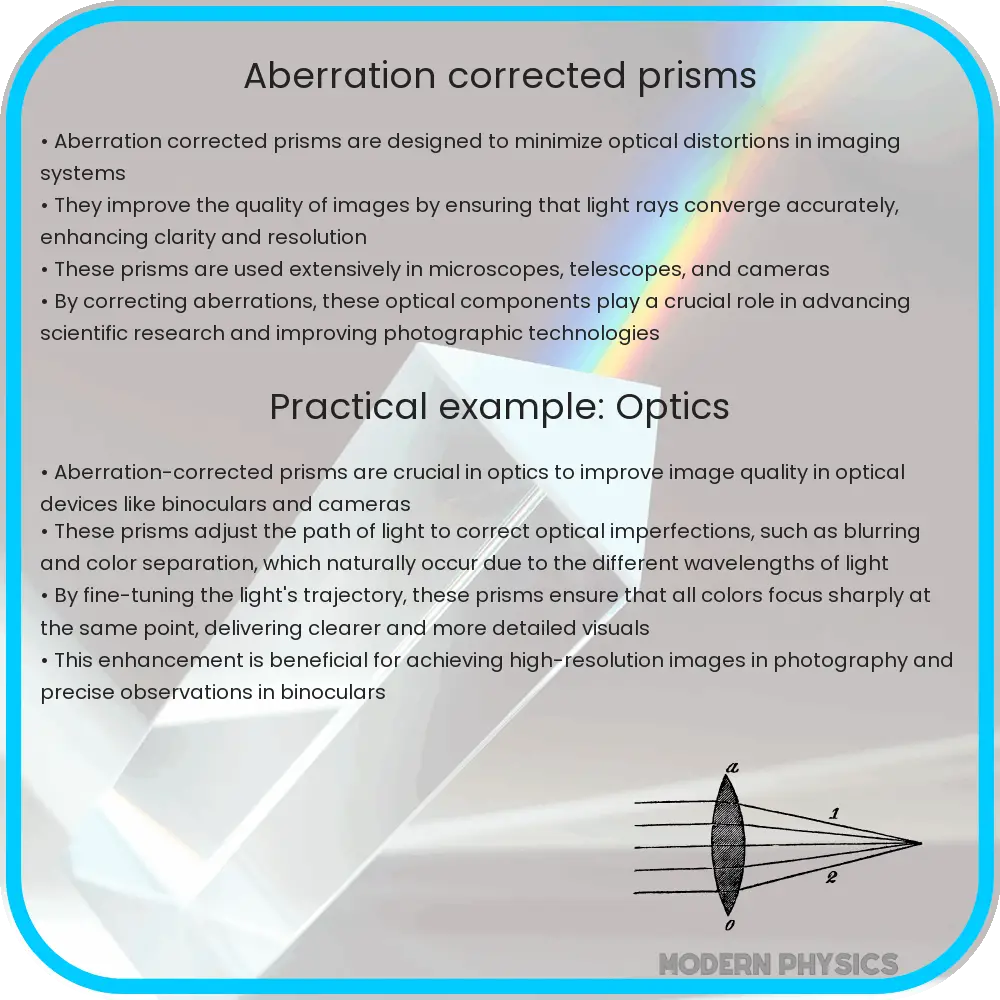
Aberration corrected prisms represent a significant advancement in optical engineering, offering enhanced clarity and precision in various applications, from microscopy to photography. These specialized prisms are designed to minimize or eliminate optical aberrations, which are imperfections that can distort the image produced by a lens or optical system.
The Science Behind Aberration Correction
Optical aberrations occur when light rays entering a lens or prism do not converge at the same point after passing through it, resulting in a blurred or distorted image. These aberrations can be categorized into two main types: chromatic and monochromatic. Chromatic aberration is caused by the dispersion of light into its constituent colors, leading to color fringing at the edges of objects. Monochromatic aberrations, on the other hand, occur even when light of a single color is used and include phenomena such as spherical aberration, coma, and astigmatism.
How Aberration Corrected Prisms Work
Aberration corrected prisms address these issues by employing sophisticated designs and materials that precisely control the path of light through the optical system. This is achieved through the use of special coatings, the careful selection of prism materials with specific refractive indices, and the incorporation of unique geometrical shapes that counteract the undesired effects of aberrations.
- Chromatic Aberration Correction: By combining prisms made of different types of glass, such as flint and crown glass, it’s possible to correct chromatic aberration. These materials have different dispersion properties, which, when properly aligned, can cancel out the color spreading effect.
- Monochromatic Aberration Correction: Geometrical modifications to the prism’s shape can effectively reduce or eliminate monochromatic aberrations. For example, aspherical surfaces can be used to correct spherical aberration, enhancing the sharpness and contrast of the image.
The implementation of aberration corrected prisms in optical systems significantly improves image quality by ensuring higher clarity, reduced distortion, and more accurate color reproduction. This makes them invaluable in high-precision applications where the fidelity of the image is paramount.
Is this conversation helpful so far?
Applications of Aberration Corrected Prisms
The versatility and effectiveness of aberration corrected prisms have led to their wide adoption in a variety of fields. In photography and cinematography, these prisms enhance the quality of images and videos by reducing optical imperfections. In scientific research, particularly in microscopy and telescopic observations, they allow for more precise and clearer imaging, facilitating the observation of minute details and distant celestial bodies. Additionally, in the realm of augmented reality (AR) and virtual reality (VR), aberration corrected prisms contribute to creating immersive and visually accurate experiences by improving the optical performance of headsets and devices.
Advancements and Future Prospects
The ongoing development of aberration corrected prisms continues to push the boundaries of optical science. With advancements in materials science and optical design, newer and more efficient ways to correct aberrations are being discovered. Innovations such as liquid crystal and adaptive optics prisms offer dynamic aberration correction, adapting to changing light conditions and viewing angles for even greater precision and clarity.
Furthermore, the integration of nanotechnology in the fabrication of prisms holds the promise of ultra-compact optical devices with unprecedented performance. These advancements not only enhance the capabilities of current applications but also open the door to new technologies and discoveries in the optical field.
Conclusion
Aberration corrected prisms stand at the forefront of optical technology, providing solutions to age-old challenges of image distortion and blurriness. Through the meticulous design and selection of materials, these prisms enhance the clarity, precision, and overall quality of optical systems across a wide range of applications. As technology progresses, the potential for even more sophisticated aberration correction techniques promises to further revolutionize the field of optics. Whether in scientific research, entertainment, or technology development, the impact of aberration corrected prisms is both profound and far-reaching, marking a significant milestone in our quest for perfecting the way we see and interpret the world around us.