
Explore the art and science of aspheric mirror fabrication, covering benefits, techniques, materials, and the latest advancements in optical technology.
Understanding Aspheric Mirror Fabrication
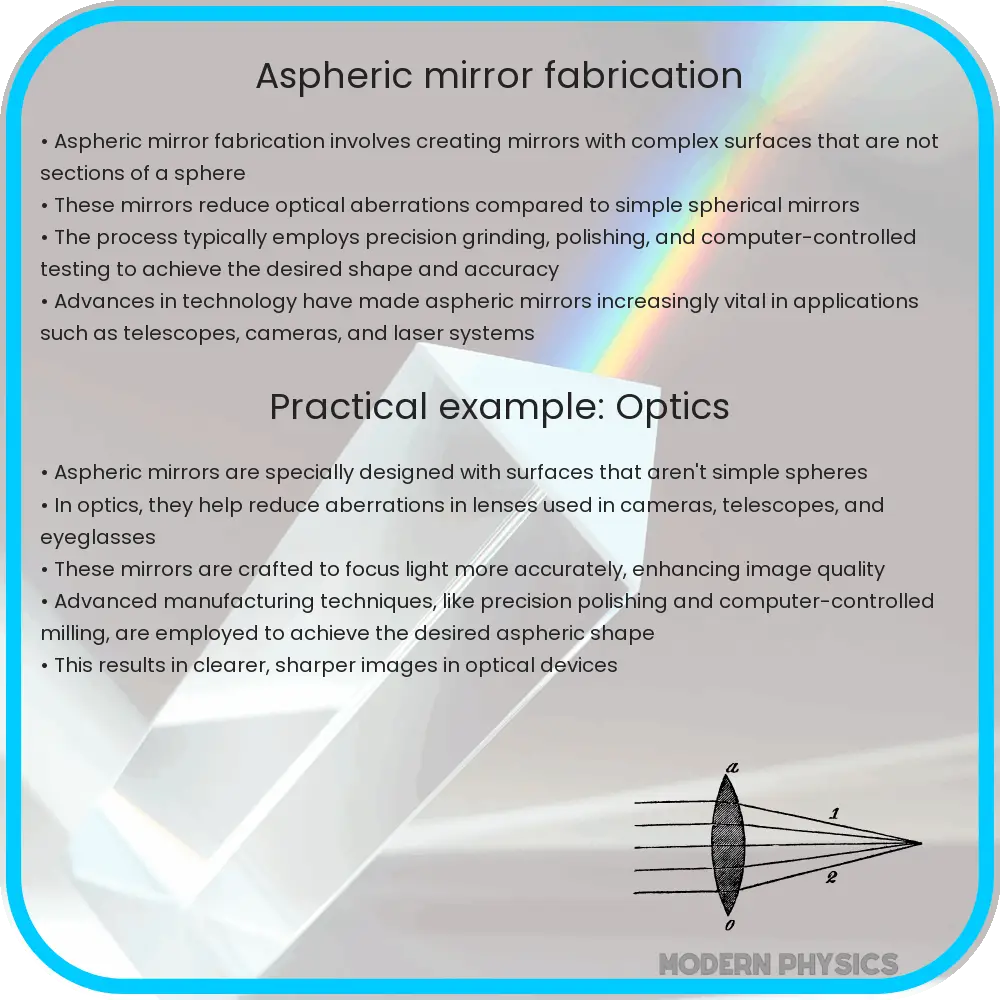
Aspheric mirrors are a cornerstone of modern optical engineering, offering superior performance over traditional spherical mirrors by reducing spherical aberration. This advanced type of mirror deviates from the simple spherical surface to a more complex shape, enabling it to focus light more accurately. The fabrication of aspheric mirrors involves precision, clarity, and efficiency, incorporating state-of-the-art technology and meticulous processes to achieve the desired outcome.
Key Benefits of Aspheric Mirrors
Aspheric mirrors are highly sought after for their ability to provide clearer images and more compact optical systems. By eliminating spherical aberrations, they allow for higher quality imaging in telescopes, cameras, and laser systems. Furthermore, their unique shape can contribute to the reduction of system size and weight, making them ideal for applications in aerospace and portable electronic devices.
Fabrication Techniques
- Computer Controlled Polishing: This method employs advanced computer algorithms to control polishing equipment, gradually removing material to achieve the aspheric shape with high precision.
- Magnetorheological Finishing (MRF): A highly precise technique that uses a magnetic field to shape a fluid-based polishing tool. MRF is especially useful for final surface finishing, ensuring the mirror meets exact specifications.
- Ion Beam Figuring: An ultra-precise finishing process that uses a beam of ions to remove material from the mirror surface. This method is ideal for correcting the tiniest deviations in the mirror’s shape.
Materials and Coatings
The choice of material for aspheric mirrors depends on the application’s specific requirements, including thermal stability, weight, and reflectivity. Common materials include glass, fused silica, and metals like aluminum and beryllium. To enhance performance, mirrors are often coated with reflective materials such as aluminum or silver, and protective overcoatings like silicon dioxide (SiO2) to prevent oxidation and enhance durability.
Challenges in Aspheric Mirror Fabrication
Despite the advantages, fabricating aspheric mirrors poses significant challenges. The complexity of their shape requires advanced manufacturing techniques and meticulous quality control to ensure each mirror meets the rigorous standards required for its intended use. Additionally, the need for specialized equipment and expertise can make the fabrication process more costly and time-consuming compared to conventional mirrors.
Advancements in Aspheric Mirror Fabrication
Recent advancements in fabrication technology have led to significant improvements in the precision and efficiency of aspheric mirror production. Innovations such as laser-assisted machining and additive manufacturing (3D printing) are paving the way for more complex and precise mirror designs. These technologies allow for the direct fabrication of aspheric shapes, reducing the need for extensive post-processing and thereby lowering costs and production times.
Quality Assurance and Testing
Quality assurance plays a crucial role in the fabrication of aspheric mirrors. Rigorous testing methods, including interferometry and surface profilometry, are employed to verify that the mirrors meet strict optical performance criteria. These tests ensure that the mirror’s surface profile matches the designed aspheric curve with high precision, guaranteeing optimal performance in its final application.
Applications of Aspheric Mirrors
Aspheric mirrors find applications in a wide range of fields, from consumer electronics, such as camera lenses and smartphone optics, to more specialized areas like astronomical telescopes, laser systems, and optical communication devices. Their ability to provide superior image quality and compact form factors makes them indispensable in the advancement of optical technology.
Conclusion
The fabrication of aspheric mirrors represents a fusion of art and science, requiring precise engineering and advanced technologies to produce mirrors that meet the highest standards of clarity and efficiency. As the demand for higher performance optical systems continues to grow, the importance of these specialized mirrors in enhancing the capabilities of optical devices cannot be overstated. Despite the challenges associated with their production, ongoing advancements in manufacturing techniques are making aspheric mirrors more accessible and affordable. With their unparalleled ability to improve optical performance, aspheric mirrors are set to remain at the forefront of optical technology, pushing the boundaries of what is possible in imaging, communication, and beyond.